5 Self-Sabotaging Phrases Software Engineers Need to Stop Saying (And What to Say Instead)

I’m tired of hearing software engineers complain.

Yes, there are unfair managers, incompetent colleagues, systematic barriers, frustrating bureaucracy, and much, much more. Identifying problems is useful. Getting stuck in a cycle of negative emotions is not.

The sad thing is that some software engineers say things that result in subconscious self-sabotage. Some of these phrases are downright toxic.

So, let’s identify 5 self-sabotaging phrases software engineers need to stop saying, why they’re harmful, and what you should say instead.

“No one knows what they’re doing.”

This phrase is secretly dangerous. Think of this in the context of “When I was a kid, I thought adults had it all figured out. But now that I’m an adult, I don’t know what to do. And If no one knows how to do anything, I don’t need to do anything either. I guess I’ll suffer too. LOL!”

“No one knows what they’re doing” can become an excuse for ignorance and laziness. I see a lot of self-deprecating developers joke about how little they know (and to be fair, I’m guilty of this too). For instance, I see memes on Imgur making fun of how fat/lazy/sad/lonely/broke/etc. the poster is. They’re funny, but I fear that looking at too many of those memes is bad for your mental health.

The truth is, a lot of adults have figured out many parts of their life. They just don’t talk about it. If someone has become successful in one domain, some of their friends resent their success, and they get “crabs in a bucket” syndrome. So, people downplay the countless hours of hard work that went on behind the scenes. It’s much easier to smile, shrug, and say “I don’t know how I did it. I guess I was lucky.”

Critics will say, “The system is set up so I can’t win!” It’s true that people in certain demographics have a harder time succeeding in certain domains. It doesn’t follow that you should immediately give up. Even if you don’t achieve perfection, you can change yourself and the people around you. Martin Luther King Jr didn’t solve 100% of racism, but he made a tremendous mark on history.

Going back to a more personal level, there’s nothing stopping you from starting to make an improvement tomorrow. For example:

The point is, if you want something to change, you have to take action. No one is guaranteed a specific job or a promotion. The best you can do is to give yourself every possible advantage that you can control.

So instead of saying “No one knows what they’re doing,” try “I don’t know yet, but I’m going to find out.”

“But Don,” you whine. “I don’t have what it takes. I’m tired. And I don’t even know how to start.”

“Yes you do!” I reply. “You’re smart, and you can keep learning. Look at how far you’ve come already.”

Which brings me to my next point…

“I’m not good enough”

Or its cousin, “I’ll never be like them”.

Impostor syndrome is real. When you’re a student, you look out and see so many intelligent, successful people. When you start out your first job, you’re surrounded by more senior engineers. And when you’re a senior engineer, they’ll always be someone who is more experienced and more accomplished then you.

So you think to yourself, “I don’t belong here. I’m not good enough to be here. They’re going to see how dumb I am and I’ll lose my job.”

When you catch yourself thinking or saying “I’m not good enough”, realize that you already passed the interview. You’ve already proved yourself capable enough to handle the job.

And consider this: all those other engineers spent a lot of time developing their skills. (Some of them may have been simply lucky, but in that case, there’s not much to learn from them.) They are not intrinsically better than you. If you keep learning and sharing your knowledge, one day, someone will look up to you, too.

But what if you want to learn a skill, but you keep putting it off? “After all,” you remind yourself, “I’m so busy these days. I need to fold the laundry, text my mom, and go to the gym. And I should get to bed earlier. I have no time left to do anything else. Maybe I’ll do it next week. Ugh, I’m so lazy.” That brings me to my next point…

“I should X”

This means phrases like:

A lot of people beat themselves up over not doing something. Saying “I should X” over and over doesn’t do you any good. Guilt is not productive emotion!

It irks me when my friends complain wistfully, “I want to learn Spanish/guitar/etc”, for years, and they never get started. I suppose they don’t want to learn it that much.

Instead, decide to do the thing or not. Block off some time on your calendar to do the thing, or acknowledge you won’t do it in the near future. You might decide to pause one thing to prioritize another. And you should feel OK with your decision. It’s not reasonable to do everything all at once.

Instead of saying, “I should learn X”, I’d rather hear people say, “I want to learn X one day, but right now, I’m really focused on Y. And I’m excited about Y because…” That sounds like someone who has made a conscious decision.

Let’s say you move from “I should get a new job” to “I’m actively looking for a new job”. Great! You go to a conference to make new connections. You feel awkward shuffling from table to table, unsure of how to introduce yourself in a noisy, stuffy convention hall. The event ends, and as you trudge towards the exit without any strong leads, you feel like you were born with a natural -5 to charisma.

Which brings me to my next point…

“I’m not good at talking to people”

This might be true today, but this shouldn’t be an excuse. Communication skills are just skills. They can be learned just like riding a bike or SQL.

And, communication is a superpower. As you advance in your career, you’ll need a higher level of communication skills. You can be the smartest person in the room, but if you can’t convince other people to work with you, you’ll be limited in what you can accomplish. And if you can bring a highly talented team together, you can do anything.

If you don’t feel confident in your communication skills yet, do NOT say, “I’m not good at talking to people”. Instead, say “I’m still working on my communication skills” or “I’m not good at talking to people yet.” You’ll get better with practice.

Imagine you practice your communication skills in the real world. You activate hustler mode, invite some friends out for milkshakes, go to multiple networking events, and haggle with some street vendors… After a few months, you feel so confident at talking with people! But today, you feel like you need to rest.

Lying in bed, your phone buzzes. A text from your friend! She invites you to the new German beer garden in Mountain View, but you’re too tired to go. I hope you don’t respond with the next phrase…

“I’ll see if I can make it”

The San Francisco Bay Area is a beautiful place. It has a vibrant culture, perfect weather, and plenty of magnificent landscapes within a 3 hour drive.

But with this beauty comes the “San Francisco yes”. This is when people say things like “I’ll see if I can make it” and “I’ll see if I can swing by.” They don’t want to commit to a clear yes or no, and it’s often used to “politely” decline an invitation. Sometimes they say give a San Francisco yes when they have absolutely no intention of attending.

To the recipient, this is a terribly impolite answer. People want a clear yes or no. People are not be offended if you decline an invitation. In fact, saying “yes” and then not showing up is even more rude. You’ll quickly become known as an unreliable person.

Do your friends a favor. If they invite you out on a hike (or whatever social activity), and you don’t want to go, say, “I can’t go, but I appreciate the offer.” Your friend will thank you for the clear answer.

When you become known as a reliable person, people will like you. They’ll trust you. You’ll build new connections, develop new skills, and grow as a person and a software engineer.

And with enough time, you’ll forget you used to say these harmful phrases altogether.

Posted in Software | Tagged , , , , | 3 Comments

Not All Complaints Are Created Equal

Photo by cottonbro studio on Pexels.com

People always find a reason to complain, no matter how polished the product is. Especially the manager on one of my previous teams at Google.

Every few days, my manager and I would sit down together and open our iPhone app. He would describe all the problems that he saw on the main page. Then, I would furiously scribble notes and try to fix each bug before our next meeting.

One week, he had a complaint like “This page shows no content.” That was a severe problem! I started investigating ASAP.

Once the empty page bug was resolved, my manager said, “There’s not enough whitespace between this button and this label.” That meant there were no more big issues, and I was doing a good job. I set the margin from 2 pixels to 8 pixels and got back to my refactoring project.

The next day, our product manager came by and said, “There’s too much whitespace here!” So I reduced the margin from 8 pixels to 4 pixels.

Inevitably, my manager reported another bug saying the whitespace was incorrect at 4 pixels. (So what was it supposed to be?) At that point, I just said, “Let me check the UX spec.”

Of course, there was no UX spec for iOS. At Google, they only provided a spec for Android. So I quietly ignored the bug and got on with the rest of my work. Oddly, everyone forgot about their whitespace requests within a week.

What a strange team.

Posted in Software | Tagged , , , , , , , | 2 Comments

The Four Multipliers that Secretly Influence Your Salary (and Society)

Last year, Sundar Pichai earned 226 million dollars, which is 800 times more than the median salary of an Alphabet employee.

You might ask, “How can Sundar Pichai do as much work as 800 people?” – obviously, he doesn’t. There are secret factors at play. I want to talk about these secret factors that influence everyone’s salary, from the biggest CEOs to the humblest custodian.

To really understand what’s going on, you have to understand that people pay you to do one of two things:

  • Solve problems
  • Distract them from their problems (AKA, entertainment)

It’s also possible to cheat people out of their money, but I’ll assume that you’re only interested in deception while playing hidden identity games like Werewolf :)

Anyways, think of an ordinary job, like a barber. If you cut one person’s hair, you get $X. If you cut 2 people’s hair, you get $2X. In a job like this, you’re limited by your time.

But not every job is like this. Some jobs are more intertwined with a multiplier–something that lets you produce more in the same amount of time.

There are four multipliers: labor, capital, media, and code. None of them are good or bad, nor better or worse than the others. They are simply tools used to shape the world.

We Need to Go Back

The four multipliers are intertwined with the story of humanity.

Think back to prehistoric times. There are tales of mythical heroes who brought groups of people together to build the first stone-age irrigation systems or defend their homeland. They became kings and queens. These individuals had power and influence because they could direct human labor to create something new. In practice, labor is the ability to have other people do work for you.

With the growth of agriculture, humans could store wealth in grain. Soon, people traded in complex ways, humans developed metal currency, and capital was born. Capital is like a shortcut to more labor.

Centuries later, the first blursed (blessed and cursed) printing press was built. Media like books, newspapers, radio, movies, and television began to proliferate. A single author had the ability to reach millions of people like never before. And with their ability to inform (or misinform), the author could change the way people think and behave.

In the 20th century, technology became the new hottest multiplier. A developer can write a program for a fixed cost. Then, that code can run an infinite number of times and solve an infinite number of problems. It’s genuinely impressive.

Code touches the other multipliers in a unique way. Code helps set delivery schedules (labor), automate stock trading (capital), or allow some guy in his F-150 share his political rants on the Internet (media). And, further automation allows writing even more code.

Back to the Present

So where does that leave us today?

Jobs that are infused with multipliers have the ability to make more money than other jobs.

As a manager, you use the power of labor. You have the ability to direct people to do work and solve problems. In a team, you can accomplish more than any of you could do alone.

As an investor, you use the power of capital. Whether you trade one share of VTSAX or a million, the cost to make a decision is the same. And you get to reap the reward of your sound judgment–or suffer dearly for making a bad trade.

As an influencer, you use the power of media. You can shoot videos and reach millions of people around the world. You might even be able to convince them to do something for you–or for the planet.

And as a software engineer, you use the power of code. You have the power to command machines to solve very difficult problems and change people’s lives–hopefully for the better.

Today, we see the power of code in Silicon Valley. There, people worship ambition for ambition’s sake. The impact of code is created by software companies large and small, from the hottest startup to FAANG.

We can also find media embodied in another area: Los Angeles. There, people desire image–they would rather flaunt their good looks and virtue than live a quiet life. The power of media is flashed across the globe through Hollywood’s TV shows, music, and movies.

On the other side of the country, we see capital manifested in New York City, where people chase money (and not necessarily wealth). The power of capital is extended through the international banks on Wall Street.

Finally, Americans can find the embodiment of labor in Washington, D.C., where people worship the very idea of power. The control of labor is codified through government and law. Remember, labor is getting other people to do work for you, and the government’s job is to tell people what they can and can’t do.

In Practice

Beyond salary, why does this matter?

In order to change the world, you can’t just use one multiplier. Even the president, who sits at the head of the US government, can’t control everything. The president has to contend with the other multipliers: capital, media, and code.

To truly change society, all four multipliers must be working together.

And to get back to Sundar Pichai and his 226 million dollar compensation package, the four multipliers show a framework for how he earns this much money: a tech CEO touches every multiplier.

The company has a lot of employees who solve problems for customers. The CEO sets the strategy and influences every product line.

The company has a lot of money. The CEO ratifies where to invest and how to spend it.

For social media products like YouTube, recommendation algorithms have the potential to empower or silence voices. The CEO can step in and change YouTube’s strategy if needed. Additionally, the CEO can easily get interviews on major news networks.

And in a tech company, every product and service is intertwined with code. After the upfront investment, the code can continue running and serve millions of customers.

Once again, I’m not saying any of this is good or bad, or how something “should” be done. This article is just about pulling back the curtain and revealing the game that’s being played around us as software engineers.

Because if you want to play, you have to know the rules first.


The four multipliers are based off of ideas I learned from prior work by Van Jones and Naval Ravikant years ago. I say this not to name-drop, but to give credit to the people who indirectly influenced this article.

Posted in Software | Tagged , , , , , , , , , , | Leave a comment

Get the top rating in your next performance review with this one weird trick

Google changed its performance review system, and chaos was everywhere. The new system was called GRAD (Googler Reviews and Development), and after it was announced, there was a boatload of questions. ICs asked their managers, managers asked their directors, directors asked their VPs, VPs asked the CEO, and the CEO deferred to the GRAD team, whose documentation was incomplete. Trying to change course for a company of over 100,000 people is no easy task.

Despite the uncertainty, I looked at the situation, cut through the chaos, and received the highest performance rating at Google and a 14% raise. Only one other engineer and I in my director’s organization received this rating. My secret was this one weird trick (and my manager loved it).

But before I can tell you what I did, we have to go back.

The Rubric

A year ago, when GRAD was announced, I examined the rubric for my role, L5 software engineer. The rubric had attributes relating to contribution, challenge, leadership, and teamwork.

As I planned projects over the next year, I kept this rubric in the back of my mind. How will each of my projects demonstrate each aspect of the rubric? How can I fulfill my responsibilities and go the extra mile?

And every week, I had a 1:1 with my manager where we discussed exactly this.

Using 1:1s to my advantage

The first item on our recurring 1:1 agenda was always GRAD. I shamelessly asked two questions:

  • What is my expected GRAD rating?
  • What can I do to get to the next rating? (Or at least, to increase my chances?)

Then we talked about the same strategic 1:1 topics that I used leading up to promo.

Some people are scared to talk about performance reviews. Pardon my language, but that’s a load of baloney! Your performance rating should never be a surprise. You should be in the driver’s seat, fully knowing how you’re performing against your manager’s expectations.

So, I formally wrote my expectations and agreed on them with my manager. We reviewed my projects and progress against the expectations periodically. Occasionally, we would look at the rubric together and rate myself against those unbiased, unfeeling sentences.

Then, after our 1:1, I doubled down on the things I was doing well. I found ways to compensate for my weaknesses. I worked on projects that would fill the gaps in my performance evaluation. I put thought into what projects I would work on, not just the work itself.

And at the end of each week, I wrote a few important things down.

Weekly Snippets

Every Friday, I would add my most notable pieces of my work to an internal website known as Snippets (though a regular Google Doc would work just fine). I linked to design docs I wrote, large bugs I closed, and major presentations I gave. I put in costing worksheets I crafted, production incidents I handled, and projects that I launched.­

It barely took me 5 minutes a week. And at the end of the year, I used my snippets to easily summarize my work. Nothing fell through the cracks.

But weekly snippets weren’t the one weird trick that gave me the top rating. There was one more thing I had to do.

An exaggeration, but the point remains…

Measuring Impact

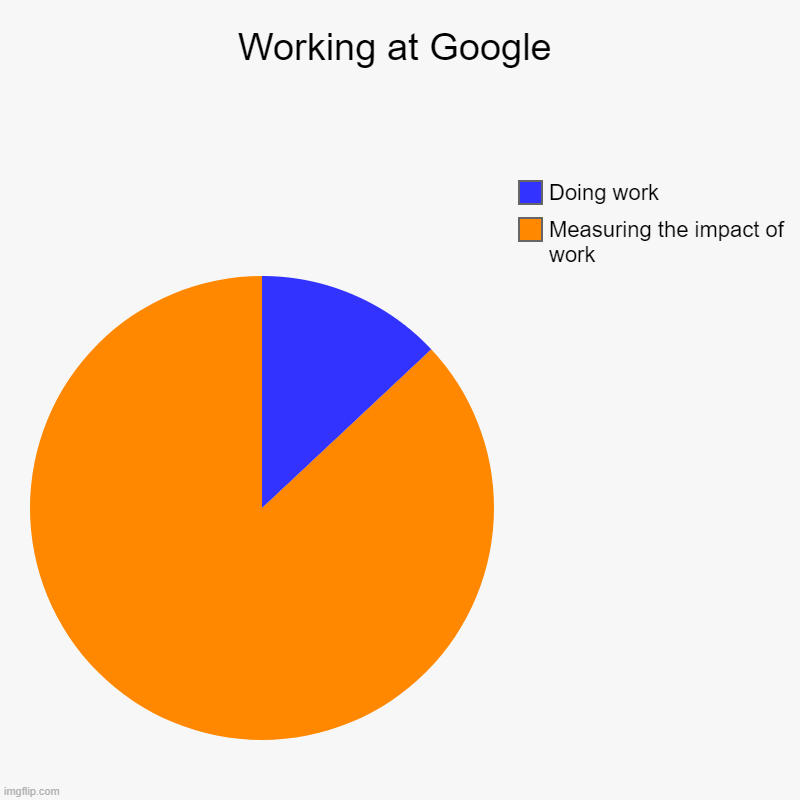
At Google, there’s a feeling that people don’t get rewarded for doing necessary work that’s difficult to measure, like maintenance or polish. The company has so many products because people want to get promoted, and launching a new app is a quick way to show something shiny to the promo committee.

Sometimes this culture irritates me because I know there are changes that ought to be made to improve the user experience, but I know they won’t move top-line metrics. So those issues sit in the backlog forever, waiting for the next intern or fixit to be hopefully picked up like a forgotten puppy at an animal shelter. GRAD is supposed to fix some of this, but institutional memory will be hard to change.

So, Googlers have to measure everything. If you launch a feature and don’t have any metrics, there’s no point to launching.

Anyways, I intentionally measured my work’s impact wherever I could. I advocated to improve our logging and to automate metric analysis. And when my teammates proposed features, I asked questions like:

  • What’s the problem we’re trying to solve?
  • What’s the impact of making this change?
  • How will you know if you succeeded?

Occasionally, these questions saved us time because we didn’t implement features we didn’t need. One of my teammates in particular really appreciated these questions because it made him think about the big picture.

Now that I had a list of projects and the impact each one made, I was finally ready to open the GRAD website.

The One Weird Trick

Here’s my secret: I wrote my own performance review, and I sent it to my manager and his manager for their feedback ahead of the deadline.

In GRAD, your manager is supposed to write your performance review. I didn’t want to rely on my manager’s memory–there were simply too many things he could miss, or simply not understand. He has many people to manage and I’m just one member of his team.

So, as the deadline for performance reviews approached, I took another look at the L5 SWE rubric. I copied each attribute from the rubric into a blank Google doc. Then, I went line by line, selecting evidence from my weekly snippets that best demonstrated each aspect of the rubric. For instance, if the rubric said, “manages projects spanning multiple quarters,” I would link to a large, complex project that I led that spanned at least two quarters. I repeated this process down the line, adding links to design docs, project proposals, costing worksheets…­ in all, it took me about an hour.

Once I had my informal self-assessment done, I sent it to my manager and his manager. I asked if there’s any other evidence they would need to bolster my case during performance reviews. My manager basically said “This is helpful, thank you.” (It also helps that I have a good relationship with my manager and my skip-level manager.)

A few weeks later, my efforts paid off. My rating was “Transformative”–the top rating, only assigned to 6% of employees. This translated into a bigger than usual annual bonus and an above-average raise.

After ratings were released, I read what my manager wrote in the official GRAD review. At the very bottom of the report, there was a line that said “After talking with Sheldon, I realize that he deserves a transformative rating due to…” This is evidence that I was originally slotted for a lower rating, but my self-assessment convinced my manager and the committee to accept the highest rating. My skip-level manager also admitted the doc helped push me over the threshold.

In the official review, I was praised for improving reliability, collaborating with other teams, mentoring Nooglers, and directing projects. I was genuinely proud of accomplishing so much with just a core team of myself and two people–I put in a lot of effort into my day-to-day work. But what surprised me most was that my efforts around diversity and inclusion were mentioned positively. I barely did anything except go to a few DEI meetings and announce events at my team’s weekly meeting. I just wanted to learn and to foster a good environment for my team. Part of GRAD includes intentionally recognizing DEI efforts, and that’s one positive change over the old system.

While all this chaos was going on, I was not attached to the outcome. Given the uncertainty around the new review system, no one was sure how ratings would be assigned, not even managers. People were especially unsure about the boundary between each rating. Last year, I got a “Strongly Exceeds Expectations”, the 2nd highest rating. This year, I was doing even more far-reaching work, so I should have maintained or increased my rating. Therefore, the highest GRAD reading was a stretch goal. The 2nd highest might have fit. The 3rd rating would’ve been an insult.

It is, however, better to ask for the highest rating you can reasonably get, and have your manager find evidence why the rating should be lower, than to argue your case upward. I guess a performance review is like a negotiation. A very long, drawn out, convoluted negotiation, but a negotiation nevertheless.

Why I wrote this article

I didn’t write this article to brag. I wanted to demystify the system, show you how to navigate performance reviews, and improve your chances of a positive outcome. And if you really don’t care about performance reviews, that’s fine. You have to see the game being played around you before you can choose to play.

Personally, I’m okay with spending time to gather evidence for a raise. A raise will benefit me for the rest of my life. Besides, this was all done during business hours as part of the review process, so I don’t see it as time wasted. Call me cynical: it’s called a performance review and not a work review for a reason.

On the other hand, some people manage to get great performance ratings seemingly without doing anything extra. And there are lots of other things to focus on in your career or in your life outside performance ratings and your salary.


With last year’s GRAD behind us, it was time to write expectations for the next year. Out of curiosity, I graded myself against the next level SWE rubric, and found that I could be hypothetically slotted into the middle rating at L6. Currently, I’m expanding my responsibilities and influence to get to the next level. I’m not in a rush, but I think I can be promoted within the next two years.

Posted in Software | Tagged , , , , | 3 Comments

How to NOT worry about layoffs

Recently, Microsoft laid off 10,000 employees. Facebook lost 11,000. Not to be outdone, Google reduced its workforce by 12,000. Overall, in the first two months of 2023, over 120,000 tech employees were laid off, including every sector and every size company.

With software engineers losing their jobs left and right and execs throwing around empty words like “rightsizing,” it’s understandable that many people are nervous about being laid off. The interview process is brutal, and the number of openings in the next few months is going to be smaller than usual. You have to search for jobs. Then, send in your resume, pass the phone screen, pass the onsite whiteboard interview, and maybe, you might get an offer. And after all that, you might like the role and the compensation and accept the offer.

Losing your job means losing your income. You might have a family that relies on you. You might be on a work visa. In the US, you might lose your health insurance. If you own a house, you might fall behind in mortgage payments and lose your property.

And once you’ve spent a lot of time working with a group of people, it’s natural to like them, or at least, to tolerate them. You might generally enjoy your team and your work. And in the chaos, it can all be taken away from you at any moment.

You can’t assume to work in the same job in the same industry for your entire life. Maybe that was true if you were born in 1950 or live in a country like Japan, but it’s extremely rare today. Even “safe” jobs aren’t really safe. The larger the organization, the more likely you’ll be hit with unexpected layoffs. Governments and large corporations only give the appearance of stability.

You can complain about the situation. This doesn’t help anyone, so I don’t recommend it.

You can try to change the situation. You can join a union or push for better labor laws in your area. Political change is difficult and will take some time.

And finally, you can recognize the emotion of the moment and let it pass through you. Then, act.

Here are 6 things you can do so you don’t need to worry about layoffs.

1. Have money in the bank

First, keep cash equal to several months of living expenses in your savings account. If you spend $4000 a month, and want 6 months of buffer, keep a balance of $24,000.

I prefer to keep one year of living expenses in my savings account. This is an incredible mental cushion. If I ever lose my job, I have at least one year to take my time to find one that I genuinely like.

If you don’t have this cash lying around yet, that’s OK. Make it easy by setting up an automatic transfer to your savings account every month. Once you’ve created a cushion, you can turn off the transfer. Don’t try to do it every month manually–you’ll forget. It’s not weakness, it’s just human psychology.

2. Demonstrate your value to your manager

The second thing to do is to be a top performer and make sure your manager knows it. This is not a foolproof way to avoid getting laid off, but it will certainly help your chances of retaining your job.

Remember: your manager is not responsible for your career development. You have to take the initiative.

If you’re not a top performer yet, the path to become one is simple:

  1. Figure out what the team needs
  2. Make it happen

(Though, it will take a lot of time and effort.)

Top performers continually demonstrate the value of their work. They drive their 1:1s with their managers. They think about how their work fits in with the larger organization and how they can help the team. They communicate effectively, unblock teammates, and blaze a trail for the people following them.

Also, being a top performer does not mean “staying late and draining your energy”–it means working on the most important tasks in a sustainable manner. With so many unreliable people doing the bare minimum, doing what you say you’ll do will get you positively noticed.

On the other hand, the prospect of being laid off is demotivating. What’s the point of putting in extra effort if you might lose your job anyway? On one hand, you’ll have a body of evidence and confidence that you can get stuff done. But still, slacking off might be the most logical thing to do in your situation, especially if you think your company is doing poorly or your team will likely be laid off. In that case, maybe pump the brakes at your job and develop your skills instead.

3. Develop your skills

As a software engineer, you already have valuable skills. Programming is going to be in demand for the foreseeable future. You probably already have a specialty, like databases, iOS development, or testing. And there are many domains around programming, like project management and technical writing. There’s always a way to leverage your experience into a new opportunity.

Soft skills are even more important when looking for a new job. You could be an extremely competent person, but if you suck at talking about your achievements in a job interview, you’ll be rejected every time.

Additionally, finding a new job is a whole other set of skills. Think about all the things you could do:

Finally, remember that you can learn new skills. You’ve done it before and you can do it again.

4. Develop your connections

Speaking of finding a new job, many people find jobs through their informal networks–colleagues, friends, and family. If you have extra time, consider activating hustler mode, going to networking events, and providing value to others. LinkedIn can also be a useful tool if you know how to use it properly.

Additionally, consider talking to a mentor. They may have been through multiple rounds of layoffs before. And if you don’t have a mentor, find one. The best software engineers are more than happy to talk to people earlier in their career.

5. Write down your unemployment plan

There’s a lot of things you could do if you get laid off. If you’re worried, your brain will jump from activity to activity, thought to thought, making no meaningful progress and draining your mental energy.

Instead of getting caught in a loop, write down the things you would do if you unexpectedly lost your job. It can be as short or as long as you like. Here’s a very brief example:

  1. Rest for 1 week
  2. Cut back on restaurants
  3. Practice interview questions on leetcode
  4. Read that book about Swift
  5. Ask Alice for a referral
  6. Practice interviewing with Bob
  7. If I can’t get a software job after six months, get a temporary job at the Krusty Krab.

(Heck, you could even make yourself a vacation plan: if you get laid off, take 3 months to backpack across Europe.)

The human mind does not like uncertainty. By writing down your personal unemployment plan, you can trick your subconscious into feeling okay. Plus, a small number of actions will get you the majority of the results. By prioritizing the important stuff, you’ll free up even more mental energy.

6. Imagine what happens if you get laid off

Finally, take a page from Marcus Aurelius and the Stoic philosophers. Imagine what would happen if you lose your job. You might feel scared. You might feel alright.

I feel like I have no need to worry about being laid off. For a few weeks, I’ve been thinking “This could be my last day going into the office.” And I’m OK with that. Every day, I’ve done my duty.

I would still be upset if I unexpectedly lost my job due to factors outside of my control. But I also understand that a person’s value is not a 1-to-1 mapping with their job or their salary. Nothing is guaranteed. I’m going to give myself the best chance I can at crafting a career and a life that I genuinely enjoy, and the rest is up to fate.

There’s a lot of things you could do. Don’t feel like you have to do everything at once. Acknowledge the emotion of the moment, and you know you will get through this.

All will be well.

Posted in Psychology, Software | Tagged , , , , , , , | 3 Comments