Three Things I Learned at a 150-Person Startup

Small server board with circuits

The “Energy Card” I used to test new scripts.

In the summer of 2013, I began my first internship at Calxeda. At first, I knew little about Calxeda itself, other than it was a 150-person company recently founded to design servers, and that I was a software intern. And since I had just completed my freshman year of college, I had no idea what to expect.

These are a few things I learned that summer:

The best way to learn is by doing

Most of my time at Calxeda was spent writing server tools and unit tests in Python, a language I had almost no experience in. Even worse, I needed to use the Linux Terminal, another tool I had rarely used.

I learned on the job by trial-and-error: writing code and querying the Internet when I didn’t know how to do something. Others at Calxeda were wonderfully smart and helped me whenever I asked. By the end of the internship, I was proficient in Python and Terminal, Git, and many other tools my classmates had yet to touch.

It’s okay to make mistakes

Due to a manufacturing defect, some of the server boards had some of their ports attached backwards. This led to me accidentally breaking a board (actually, two of them).

Later in the internship, I accidentally deleted all the variations of Linux off of a PXE server.

In both cases, I alerted the team lead. I was never punished for these errors, and I did my best to fix them. Towards the end of the internship, everyone (included myself) laughed at the mistakes we made in the beginning.

There’s still a ton to learn

Even after upgrading the firmware of several dozen servers, it took me several more months to truly understand what “firmware” meant. Nor could I identify half the cables in a server box, despite using them on a weekly basis. To this day, I still have to look at Stack Overflow for certain Git commands.

It turns out what my high school computer science teacher said was true:

The more you know, the more you realize there is to know.

I’m glad I had the opportunity to learn at Calxeda. In the following years, I was able to apply what I learned at UT, Multimedia Games, and Infusion. I enjoyed working at Calxeda, and I wish all my teammates the best for the future.

What did you learn at your first job?

Posted in Software, Startup | Tagged , , | 1 Comment

Why the Suburbs Are a Terrible Place to Live

I think the suburbs are a terrible place to live.

Don’t get me wrong. I grew up in the suburbs (as opposed to an urban or rural area) for 16 years. Places like Frisco are wonderfully safe, predictable, and often have good schools. For many people, a two-story house filled with a loving family represents the American dream.

But I think the suburbs squeeze the randomness out of life.

The Good, the Bad, and the Sterile

suburbs of Dallas

The suburbs of Dallas. Photo credit: Andreas Praefcke

While living in Plano, an affluent town just outside Dallas, I experienced both the good and the bad of the suburbs. I’ve found that the positive aspects are highly visible, while the drawbacks are difficult to notice.

This is because the nice suburbs typically exist in a bubble. You probably don’t interact with homeless people regularly, people outside your economic status, or the dirtier parts of the state. Everything is kept very clean, very sterile. And so kids growing up think the whole world lives like they do. Very orderly, very predictable. Life is linear.

“Warping” Between Locations

Life in the suburbs is very “point-A-to-point-B.” That is, you drive in a car between two places, hours neatly tucked into a schedule. You can’t walk the distance (which is probably several miles), and if you can, your first thought is to take the car anyway.

So you “warp” from place to place. There’s nothing wrong with “point-A-to-point-B” (and people outside the suburbs can have this behavior, too). However, you don’t often have the option of walking or using public transportation (choices that would release less CO2). More importantly, you don’t get the random encounters you might find on the sidewalk. In the city, you might run into an old friend, a new friend, or a massively positive rare event.

An overhead view of a planned community

An idealistic planned community.

Character Like a Two-Inch Pool

The great thing about living in the suburbs is that it gives you access to the excitement of the city and the tranquility of the countryside. Pretty, gated communities are wedged between golf courses, well-kept sporting fields and convenient shopping centers. Everything looks nice, but it lacks character.

Maybe the suburbs are intentionally shallow and sterile–like a two-inch pool. Despite the efforts of municipal art committees, it seems that most suburbs are not very distinguishable from one another. With quietness comes a sense of dullness, I suppose.

The American Dream, Utopia, or Whatever You Call it

I’m not saying that you need to avoid the suburbs at all costs. Like I said, there are plenty of advantages to “living the dream,” and these criticisms can also apply to people living in any type of town. Likewise, there are many people who live in the suburbs who don’t suffer from these problems.

My point is this: acknowledge both the good and the bad, wherever you live. With all the advertised benefits, don’t forget that nice suburbs exist in a bubble, are dependent on cars, and lack character. And remember that having the option of change is preferable to having no option at all.

What do you think of the suburbs?

Posted in Psychology | Tagged , | Leave a comment

The Future of Journalism’s Phone Interviews

Echoed could completely change the way journalists conduct phone interviews.

Five students at the University of Texas have developed a prototype iOS application called “Echoed.” The app allows the user to call any phone, record the call, and detect certain words in the conversation. And by selecting a word, the user can skip to that part of the call.

A variety of teams showcased their applications at UTApps Demo Day.

A variety of teams showcased their applications at UTApps Demo Day.

The team behind Echoed hopes to make interviews easier for journalists. Existing recording applications are difficult to use, and lack many features. Some apps cannot record inbound calls. Others require lengthy setup processes for each call. The apps on the market today are so bad that journalists prefer to hold a tape recorder up to their phone while making a call.

Echoed solves these problems by using Twilio to make calls over the Internet (like Skype). After the user hangs up, Clarify automatically transcribes as many words as it can. Within a minute or two, the user can find the parts of the recording he or she needs. No “merging calls” or weird beeps. Just dial the number, talk, and receive an “index” of the conversation.

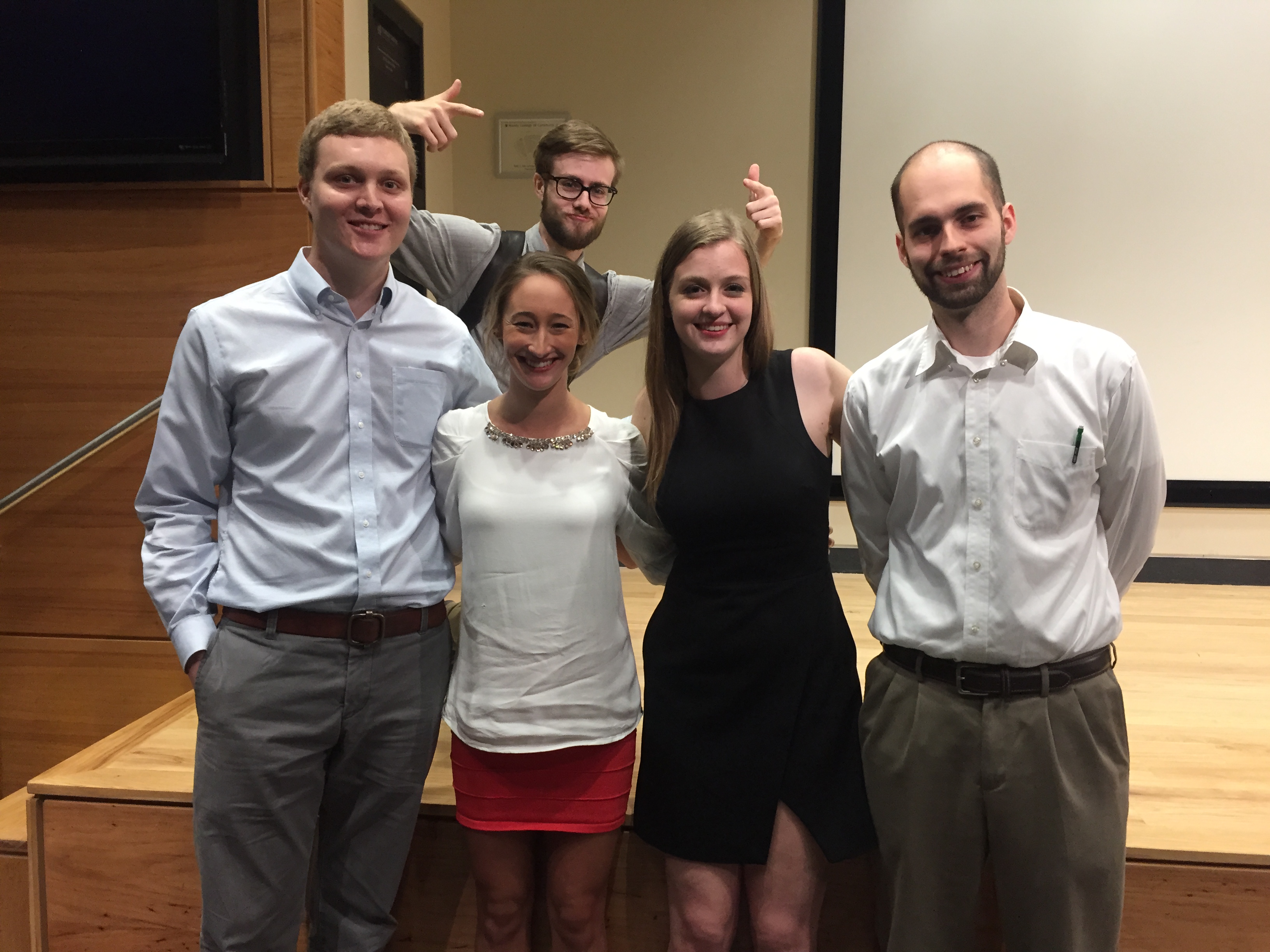
Left to right: Sam Tipton, Taylor Villarreal, Faith Ann Ruszowski, Andrew East. Back: Jacob Williamson

Left to right: Sam Tipton, Taylor Villarreal, Faith Ann Ruszowski, Andrew East. Back: Jacob Williamson

Although Echoed does not fully automate transcription–100% accuracy isn’t easy yet–the judges at UTApps Demo Day awarded “Best Overall App” to Echoed. (Another team, UniTrade, was awarded “Highest Commercial Value.”) At this time, Echoed has not announced a definite pricing model, but they estimate a 27% profit for each minute of a call.

Echoed is scheduled for release later this year. In the meantime, you like their Facebook page and follow them on Twitter.

Want to see more awesome student startups in Austin? I featured some of my other favorites just a few days ago.

Posted in Startup, Startup Spotlight | Tagged , , , , | Leave a comment

Startup Spotlight: Six Student Startups from Austin, TX

A few days ago, I had the pleasure of hearing student startups pitch at UT’s Demo Day. These students have been developing their companies for months or years, and this week they had the chance to expose themselves to investors, mentors, and anyone interested in entrepreneurship. Though not every student startup at the University of Texas pitched at the event (such as UniTrade and Echoed), I was amazed with the variety and professionalism of these startups.

Here’s a snapshot of some of my favorites:

Retell1. Retell

Retell provides property management software that automatically delegates issues to the right people. For example, when a tenant submits a maintenance request, the program can automatically contact a plumber and schedule service. Today, Capitol Factory and Tech Ranch use Retell under a pilot program. Personally, I think Retell has a ton of potential.

Entree

2. Entrée

Traditional restaurant software is expensive, difficult to use, and lacks customization. Using modern technology, Entrée aims to bring new functionality to point-of-sale systems at a fraction of the cost. This summer, Entrée plans to test its software with ten different restaurants. (Note for developers: Entrée will have the first open API for a point-of-sale system.)

beek3. Beek

Beek is a social network for Spanish-speaking book lovers. In the past few months, Beek has reached over 24,000 followers on Facebook. The company has bootstrapped itself and is positioned to continue growing. With Spanish as the third most-spoken language in the world, Beek offers 500 million people new ways to discover, recommend, and talk about books.

MyCoachlive4. MyCoachLive

Thousands of people use life coaches (similar to counselors or psychotherapists) to talk about their problems and accomplish their personal goals. MyCoachLive plans to provide a platform to connect people with life coaches via online sessions. Their team includes software developers and a psychologist with a PhD.

Photo Credit: Charlotte Carpenter via The Daily Texan

Photo Credit: Charlotte Carpenter via The Daily Texan

5. Cerebri

Have you ever called a company and waited hours for a 30-second answer? Cerebri uses artificial intelligence to answer questions in call centers, saving callers and businesses time and money. After winning $100,000 in the IBM Watson University Competition, the Cerebri team applied their technology at the United Way Texas 2-1-1 call center. Their plans for the future? Joining an accelerator and taking Cerebri to the next level.

6. FreeBee

Finally, I’d like to give an honorable mention to FreeBee, which does not have a website. This week, they announced the end of their venture. FreeBee aimed to create an electronic customer loyalty program, but a variety of factors hindered their progress. I think it was extremely noble to admit that they had failed (especially in front of a crowd of 1000 people). I wish the best of luck to the entrepreneurs behind FreeBee and all the student startups at the University of Texas.

What do you think of these student startups?

Posted in Startup, Startup Spotlight | Tagged , , , | Leave a comment

Three Reasons Austin Entrepreneurs Should Campfire at Tech Ranch

Before electricity, people would gather around campfires to talk, connect, and give each other advice. Today, “Campfire” is a twice-a-month meetup held at Tech Ranch in Austin. Even though I’m not affiliated with Tech Ranch, I find Campfire highly useful. If you’re an entrepreneur (or just interested in startups), Campfire provides a great way to meet other people in the Austin startup community. At this free three-hour event, everyone from serial entrepreneurs to new developers have a chance to solve problems and network.

So why should you participate in Campfire?

Networking

Silhouette of a cowboy

One of the main focuses of the event is making new connections. There’s a ton of talent in the Austin area, and there’s probably someone at every Campfire that can help you. At the first Campfire I attended, I met a health-tech professional, a Norwegian business consultant, a man with a PhD in the Humanities, a mechanical engineer that contracts for the military, B2B software developers, rising students at the University of Texas, and an inbound marketing guru.

Solving Your Problems

Kevin Koym, the founder of Tech Ranch, emphasizes that all participants should try to raise the value of their venture and someone else’s venture. Everyone is encouraged to give a two-minute pitch to a small group describing what they need. In my experience, this helps people practice concisely stating their ideas and what they need to move forward. The first time I attended, I was happy to tell people about “Keurig for Scented Showers,” and found some great contacts.

Tech Ranch logoHelping Others

Like I mentioned before, Campfires are about both giving and receiving help. One reason Kevin Koym likes Austin is that companies are not as cutthroat as they are in the Bay Area. Why should a B2B water-tech startup feel threatened by a grocery delivery service? At campfires, I’ve seen individuals in unrelated fields connect each other to professionals outside their native networks. Cooperation is the norm.

Whether you’ve built a multimillion dollar company or you’re just starting out, you can gain something from a campfire at Tech Ranch. If you’re interested in attending, you can see details, view the calendar, and RSVP on Tech Ranch’s website. Hope to see you there!

Posted in Startup | Tagged , , , , , , , , | 2 Comments