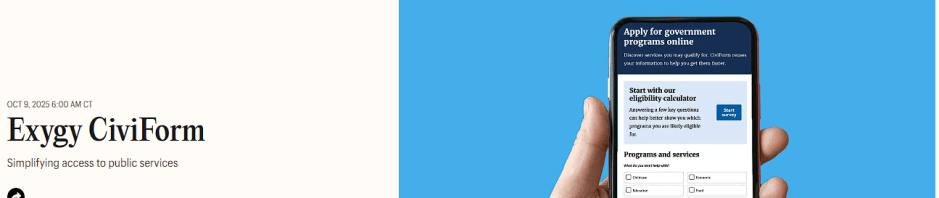
Last year, I spent six months working full-time on an open-source project with Google.org. In 2025, that project was named one of TIME’s Inventions of the Year.
Needless to say, I was surprised! I didn’t think anyone of importance would care about a software platform used by local governments.
Is it more than a website?
The platform is called CiviForm. The way I explained it to friends was like this.
Me: You know how government websites suck?
My friend: Yeah
Me: What if they didn’t suck?
My friend: 😯
Alternatively, you can watch a 90-second video about it on YouTube.
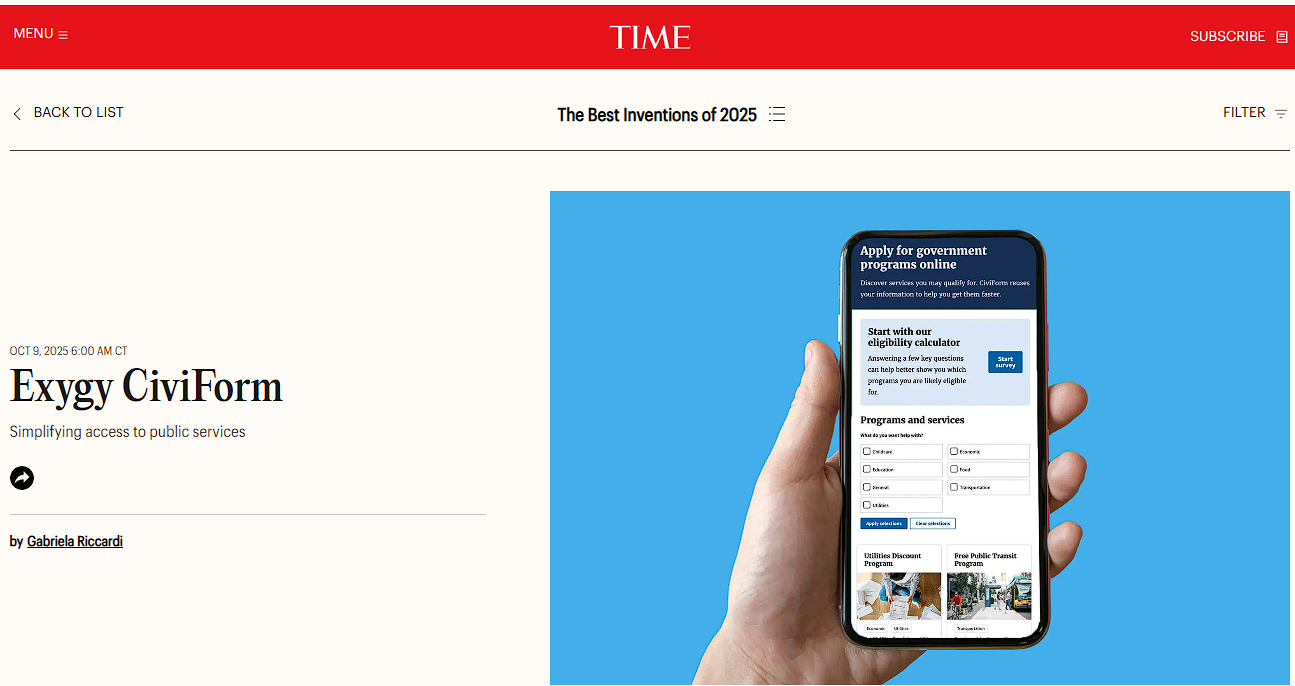
Put another way, CiviForm is an open-source project that local governments can use to serve residents. Admins can easily use a website to create programs, and then residents can apply online.
Okay, that sounds pretty standard. It’s better than printing out a paper form and dropping it off at city hall during business hours, but it’s just a website, right?
Here’s the magic: residents can create an account and reuse their information across all the city’s programs. That means they don’t have to re-enter their name, email address, phone number, driver’s license ID number, etc. 20 times.
However, resident data is not shared between CiviForm deployments. Each deployment and its corresponding data is created and managed by each government entity. For example, the city of Seattle, WA has no way to access data about a resident in Bloomington, IN.
Since CiviForm started in 2020, several local governments across the US have deployed instances, and it now covers over 8 million people.
The system was designed so that every party in the ecosystem is happy.
Residents like it because it saves them time by giving them an easy way to apply for government programs online.
Admins like it because it saves them time collecting and tracking applications.
And elected officials like it because it saves the government money.
I liked it because I was doing something good for society, learning more about software development in the process, and working with wonderful teammates. (Also, I needed something to do while I was avoiding the fallout from a reorg).
So, in true listicle fashion, here are four things I learned while working on CiviForm.
#1 Having a dedicated UX designer is a game changer
Long ago, on another team Google, I developed and shipped our iOS client for a year, practically on my own. After a year working on the project, I gave a presentation, and the UX designer remarked, “We have an iOS client?”
So, it was really nice having a UX designer on hand to answer questions.
It sounds really obvious when I say it, but if you want an app or website to look and function well, it helps to have a dedicated UX designer.
#2 Governments move slowly
Every government employee that I interacted with wanted to do good things for their residents. However, a deployment that should take 6 weeks could end up taking 6 months due to a variety of rules.
For example, each city government might require its own security audit. The security audits are performed by third-party agencies. CiviForm is an open source project, so it’s already been audited by multiple agencies. So, someone has to pay for yet another security audit and wait months for the results (which will probably be “no blockers, please proceed”).
If you want to move fast and break things, don’t partner with a city government.
#3 You can learn a lot from code reviews
I’ve long been a proponent of code reviews, and working on CiviForm only strengthened my opinion.
My main project was to migrate the user-facing UI from J2HTML to Thymeleaf. However, at the start I had almost no experience in web development.
So, I really appreciated the thorough code reviews for my teammates in CiviForm. It took me a few weeks to ramp up, but I was able to confidently execute on the project by the end.
And, thanks for their mentorship, I closed over 78 issues and merged 130 pull requests.
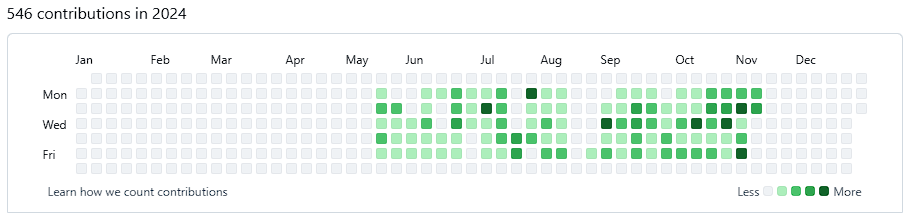
Without my teammates’ knowledge and code reviews, I would have been lost.
#4 It’s possible to have a gender balanced team
Most software development teams are mostly men. CiviForm had an even gender ratio.
I’m not sure why this is. The CiviForm team is made up of Exygy employees, Google.org Fellows, and City of Seattle employees.
I think the team is aware of unconscious bias and the hiring process does not turn away qualified candidates. There must be more.
Looking Backward and Forward
Overall, I enjoyed my 6 months working on CiviForm. I learned a lot and enjoyed working on something outside my usual scope. I was really proud that my teammates complimented me on my organization, my positive, can-do attitude, and for “doing the unglamorous work to enable us to work as a team” (like writing unit tests, documentation, and coordinating efforts between eng, UX, and PM).
Everything seems so ordinary in retrospect. Yet, we’ve already saved thousands (if not millions) of hours for city residents and admins.
And even though I was just one of many CiviForm contributors, I’m proud to have been a part of the project.


 Sheldon's Software
You must be logged in to post a comment.